Written for owners, and for the marketers and developers who implement for them.
llms.txt is a signpost, not a strategy. It is the first thing most businesses hear about when they ask how to prepare for AI assistants, and it is the least powerful of the things they should be doing. A file listing your best pages cannot fix pages that do not answer the question. And no AI agent, however capable, can compensate for business information that is missing, contradictory, or out of date.
That is the uncomfortable part of AI readiness. The work that matters most is the work that looks least like AI.
Here is what actually moves the needle, in the order it should be done.
The shift: your website is becoming a data source and an action surface
Your next customer may never see your homepage. They may describe a need to an AI assistant in plain language, and the assistant will search, compare on fit and price and policy, shortlist, and increasingly act - requesting a quote, making a booking, starting a checkout.
Winning still starts with a useful website. But the strongest businesses will also make their facts easy for a machine to verify, and their services safe for an assistant to use.
The goal is simple to state and hard to fake: be easy to find, easy to trust, easy to choose.
The five layers of an AI-ready business
Build from the foundation upward. Each layer depends on the one below it.
Accessible website — fast pages, clear navigation, stable URLs, readable content.
Answer-ready content — direct explanations, real expertise, proof, policies, FAQs.
Structured business facts — Schema.org markup and feeds for products, services, locations, and prices.
Assistant guide — a concise llms.txt pointing to your authoritative pages.
Company agent — live tools for availability, quotes, bookings, orders, and support.
Most businesses want to start at layer five. Almost all of them should start at layer one or two.
Make the website clear before you make it clever
AI systems rely on the same fundamentals that help people and search engines. Six things to get right:
One clear page per offer. Give each important product, service, location, and policy a stable page of its own.
Lead with facts. State who it is for, what it does, the price or pricing logic, availability, limitations, and the next step.
Show evidence. First-hand expertise, real specifications, named authors, case studies, reviews, update dates.
Keep access simple. Do not hide essential information behind complex scripts, login walls, or documents that cannot be indexed.
Remove contradictions. Website, product feed, structured data, and internal systems must agree.
Design the next action. Calling, booking, requesting a quote, buying, and getting support should be obvious and predictable.
The owner test: can a new visitor understand your offer, price, proof, and next step in under two minutes?
What llms.txt can and cannot do
llms.txt is a short reading list for AI systems, published at yourdomain.com/llms.txt.
What it can do: point assistants toward your most authoritative product, pricing, documentation, policy, and support pages.
What it cannot do: guarantee crawling, improve weak content, control model training, or make an assistant recommend your company.
It is genuinely useful when maintained. It is worthless as a substitute for strong pages — which is why it sits at layer four, not layer one.
A minimal example:
# Your Company
> What you do, for whom, and where you operate.

## Products and services
- Product catalogue: current offers and specifications
- Pricing: plans, fees, and commercial terms

## Trust and support
- About: company identity and expertise
- Policies: delivery, returns, privacy, and support
Keep it short, link only to canonical pages, and update it whenever your core offer changes. A stale llms.txt is worse than none — it actively points machines at the wrong version of your business.
Schema.org for products, prices, and policies
Structured data is how you label your facts so a machine can tell a company name from a product, a price from a review, a delivery window from a return window.
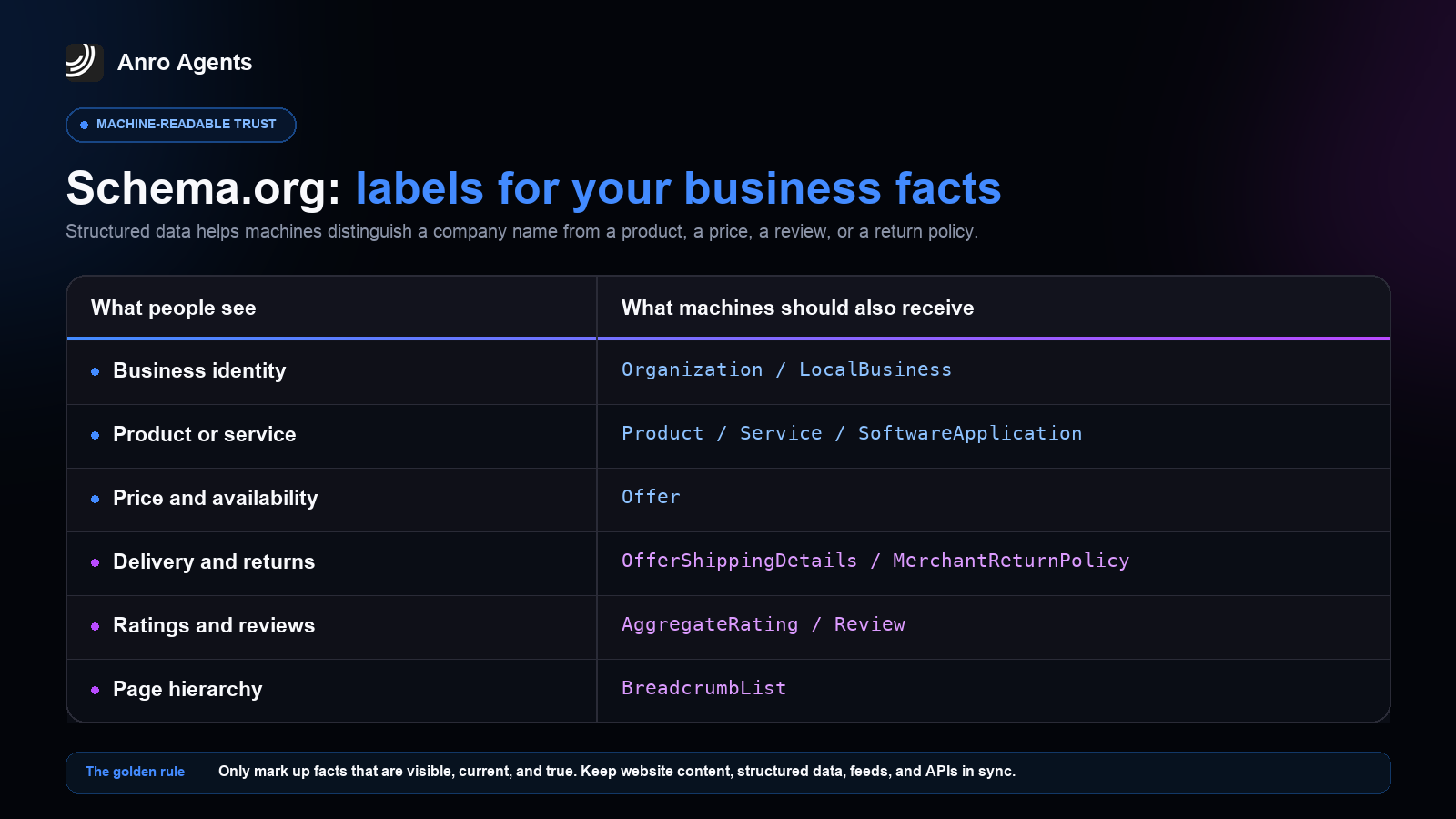
Six mappings to get right. What people see, and what machines should also receive:
- Business identity -> Organization / LocalBusiness
- Product or service -> Product / Service / SoftwareApplication
- Price and availability -> Offer
- Delivery and returns -> ShippingDetails / ReturnPolicy
- Ratings and reviews-> AggregateRating / Review
- Page hierarchy -> BreadcrumbList
The golden rule: only mark up facts that are visible, current, and true. If price or stock changes, every channel changes with it. Structured data that disagrees with the visible page is not a technical detail — it is a trust failure, and it is the failure mode most likely to get your business quietly dropped from a shortlist.
From answering to transacting: MCP, ACP, and UCP
Once your data is reliable, assistants can stop guessing from web pages and start calling controlled tools instead. The protocols, in plain language:
MCP (Model Context Protocol) — a standard way for an AI assistant to call approved business tools.
ACP and UCP — commerce protocols that define shared checkout and transaction steps.
Your systems — inventory, CRM, booking, payments, and support remain the source of truth.
A transaction looks like this in practice. The customer asks for a suitable option on Friday under a set budget. Your agent returns live options with real price and availability. The customer sees the exact offer, terms, and total. The action is confirmed.
You do not need every protocol on day one. Start with one valuable customer action and expand.
Best practices for safe transactions
An agent is useful because it is constrained. Six boundaries, none of them optional.
Separate lookups from commitments. Checking stock is not the same as placing an order.
Confirm before commitment. Show the exact item, total, terms, and delivery details before the final action.
Use the least access needed. A support tool should not carry payment or cancellation rights.
Protect payment information. Use secure, tokenized flows. Never collect card details in an ordinary chat form.
Prevent duplicates. A retry must not create a second booking, order, or charge.
Keep an audit trail. Record what was requested, approved, changed, and completed — without exposing secrets.
The trust test: could a customer see what will happen, correct a mistake, decline, and get human help?
FAQ
What can llms.txt do, and what can it not do?
llms.txt can point AI assistants toward your most authoritative product, pricing, documentation, policy, and support pages. It cannot guarantee crawling, improve weak content, control model training, or make an assistant recommend your company. Keep it short, link only to canonical pages, and update it whenever your core offer changes.
Do I still need llms.txt if I already have a sitemap?
They do different jobs. A sitemap lists everything and says nothing about importance. llms.txt is an edited shortlist with a sentence of context, telling an AI system which pages are authoritative for your prices, policies, and products. Publish both, and keep the sitemap complete and the llms.txt short.
Which Schema.org types should a business mark up?
Organization or LocalBusiness for business identity, Product or Service or SoftwareApplication for what you sell, Offer for price and availability, ShippingDetails and ReturnPolicy for delivery and returns, AggregateRating and Review for ratings, and BreadcrumbList for page hierarchy. Only mark up facts that are visible, current, and true.
What is MCP, and how does it relate to ACP and UCP?
MCP, the Model Context Protocol, is a standard way for an AI assistant to call approved business tools such as availability, quotes, or bookings. ACP and UCP are commerce protocols that define shared checkout and transaction steps. Your own systems for inventory, CRM, booking, payments, and support remain the source of truth. You do not need every protocol on day one.
What are the safety boundaries for letting an AI agent transact?
Separate lookups from commitments, confirm the exact item, total, and terms before the final action, grant the least access needed, use secure tokenized payment flows, make retries idempotent so they cannot create a duplicate order or charge, and keep an audit trail of what was requested, approved, changed, and completed.
Where should a business start becoming AI-ready?
Start at the lowest layer that is failing, not with an agent. The layers are an accessible website, answer-ready content, structured business facts via Schema.org, an llms.txt assistant guide, and finally a company agent with live tools. Pick one high-value customer journey and make it reliable before expanding.
How long does this take?
A focused first pass fits in about 90 days: two weeks to choose the journey and fix the core pages, a month to repair structured data and publish llms.txt, a month to expose one read-only agent capability and add a draft quote or booking step, and a final two weeks to test real customer prompts and measure. Expand only after the first journey is reliable.
A note on this page
This article is marked up with Article and FAQPage structured data, and our own llms.txt is published at anroagents.com/llms.txt. We would rather be checked than believed.
Get the full guide
The free 12-page PDF, Make Your Website Ready for AI, adds what does not fit in an article: a practical 90-day roadmap (clarify, structure, connect, prove) and a business-owner readiness scorecard you can mark Yes / Partly / No to find the layer that is actually holding you back. It also lists the primary sources behind everything above.
Turn the roadmap into a working company agent
ANRO Agents helps businesses create company AI agents grounded in their own knowledge and connected to existing workflows.
Grounded answers — use your services, FAQs, contacts, files, and URLs as the agent's knowledge.
Connected workflows — CRM, calendars, APIs, payments, lead qualification, email follow-up, and live handoff.
Assistant-ready access — manage approved capabilities through MCP or OpenAPI from ChatGPT, Claude, Gemini, and other compatible AI tools.
Start with one valuable customer journey, prove that it works, and expand from there.
Updated August 2026. Standards and platform programs in this area continue to evolve; this guide is strategic information, not legal, security, or platform-certification advice.