AI agent discoverability is whether an AI agent, acting on a customer's behalf, can find your business, verify what you sell, and interact with it directly, without a person clicking through your website first. One layer of that is already deciding vendor shortlists today. Another is just beginning to form. This article covers both: what's already working, and what's worth getting ahead of.
Key Takeaways for AI Agent Discoverability
AI agent discoverability means an AI agent can find, verify, and transact with your business without a person having to browse your site first.
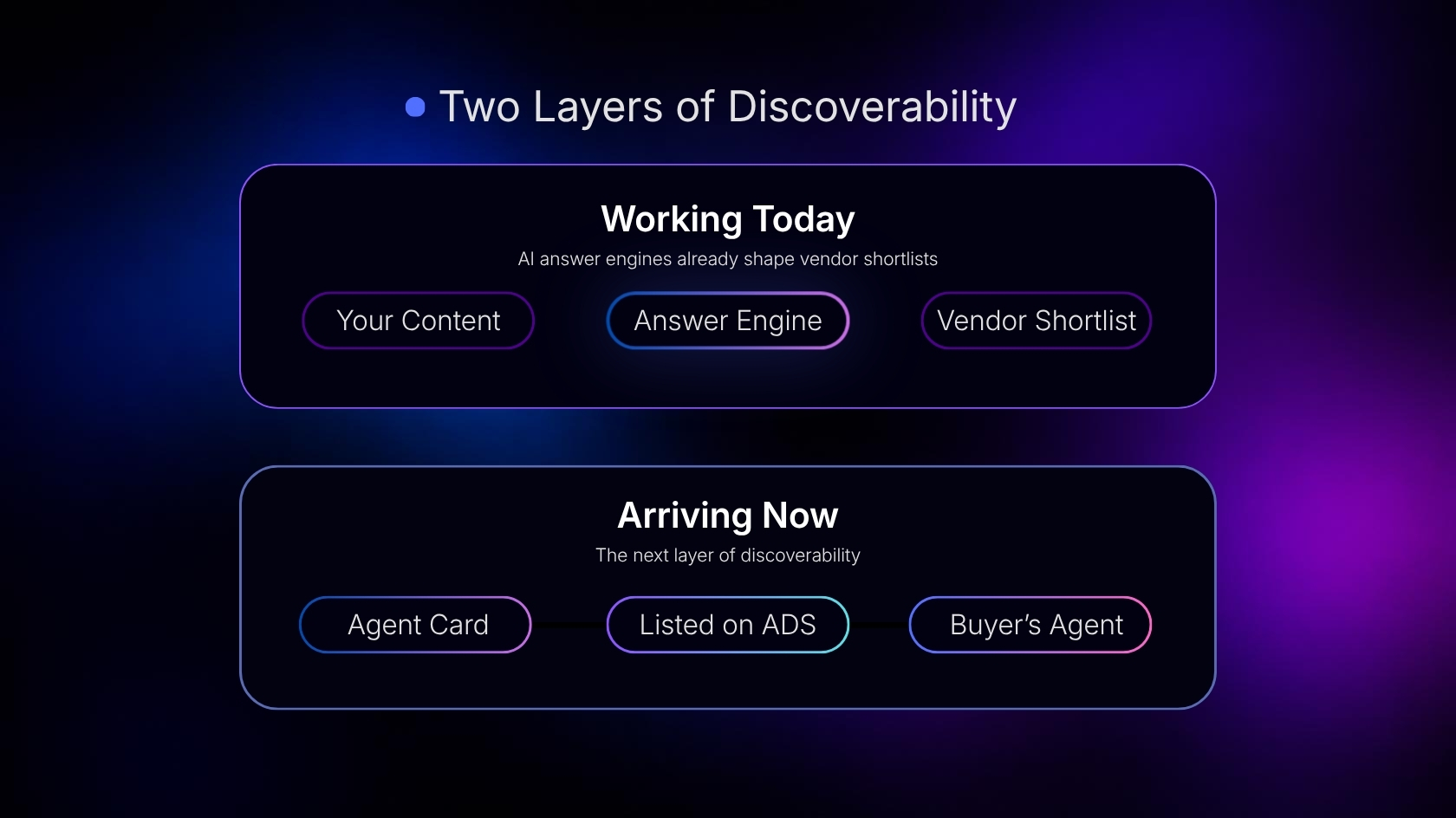
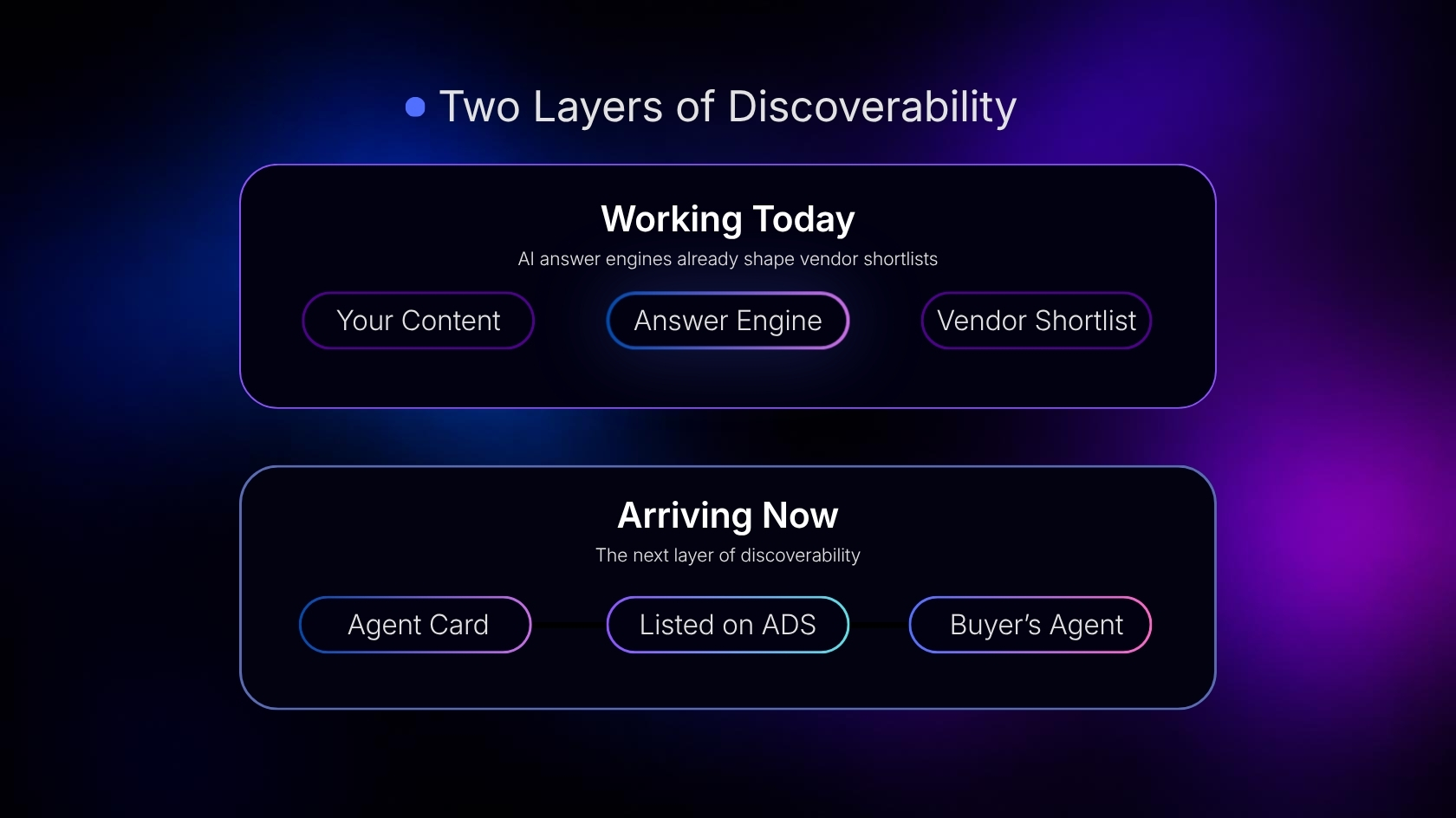
Right now, AI answer engines like ChatGPT, Perplexity, and Copilot already shape vendor shortlists by reading the ordinary web: structured content, Schema.org, llms.txt, and facts that hold up across every channel.
Agent-to-agent discovery, A2A Agent Cards, and ADS records are arriving next. It's early, moving fast, and cheap to adopt ahead of everyone else.
As agent-to-agent discovery matures, a business with no published agent record won't be part of that comparison – and getting ready takes days, not a rebuild.
What Is AI Agent Discoverability?
AI agent discoverability is the degree to which an AI agent can locate your business, confirm what you offer, and complete an action with it (a quote request, a booking, a purchase) without a person involved on either side.
It's a different problem from SEO, which optimizes for a person scanning a results page, and a different problem from AI agent discovery, an enterprise term for cataloguing the agents already running inside a company's own systems.
It's also not one problem; it's two, on two different timelines. One layer is already deciding shortlists today. The other is just starting to exist.
Working Today: AI Answer Engines Already Shape Vendor Shortlists
Right now, when a buyer asks ChatGPT, Perplexity, or Copilot to find or compare a supplier, the answer comes from reading the ordinary web: your pages, your structured data, your llms.txt file. No protocol, no directory, no agent-to-agent handshake required. This layer is the one already deciding who makes a shortlist.
Getting found here depends on the same fundamentals covered in AI-Ready Websites: llms.txt, Schema.org & MCP; accessible pages, direct answers, Schema.org markup, and facts that stay consistent wherever an AI tool encounters them.
Forrester's State of Business Buying, 2026, based on nearly 18,000 global buyers, found that generative AI searches have become the starting point for how B2B buyers discover and evaluate vendors – though buyers still lean on human validation before deciding, since AI answers alone can be incomplete or unreliable (Forrester, January 2026).
Arriving Now: Agent-to-Agent Discovery
Alongside answer engines, a second layer is forming: agents that negotiate and transact directly with your business's own agent, while a person steps in only where it matters rather than managing every step. Adoption is still early, and the scale it's heading toward is large enough to plan for now rather than later.
Gartner forecasts AI agents will handle 90% of all B2B purchases within three years, intermediating more than $15 trillion in spending through exactly this kind of machine-to-machine negotiation (Digital Commerce 360, November 2025).
1. The A2A Protocol | Agents Talking Directly to Agents
A2A, the Agent2Agent protocol, lets one AI agent hold a real conversation with another instead of just reading its listing. Each agent publishes an Agent Card, a machine-readable description of what it can do, at a fixed, discoverable URL, so another agent can look it up and negotiate directly rather than infer capabilities from a webpage.
Google launched A2A in April 2025 with 50+ founding partners, then donated it to the Linux Foundation two months later (Linux Foundation, June 2025).
At its one-year mark, the number of supporting organizations had surpassed 150, including AWS, Cisco, Microsoft, Salesforce, SAP, and ServiceNow (Linux Foundation, April 2026).
See how Anro Agents implements A2A Agent Cards for a working example.
2. ADS | AGNTCY's Agent Directory Service
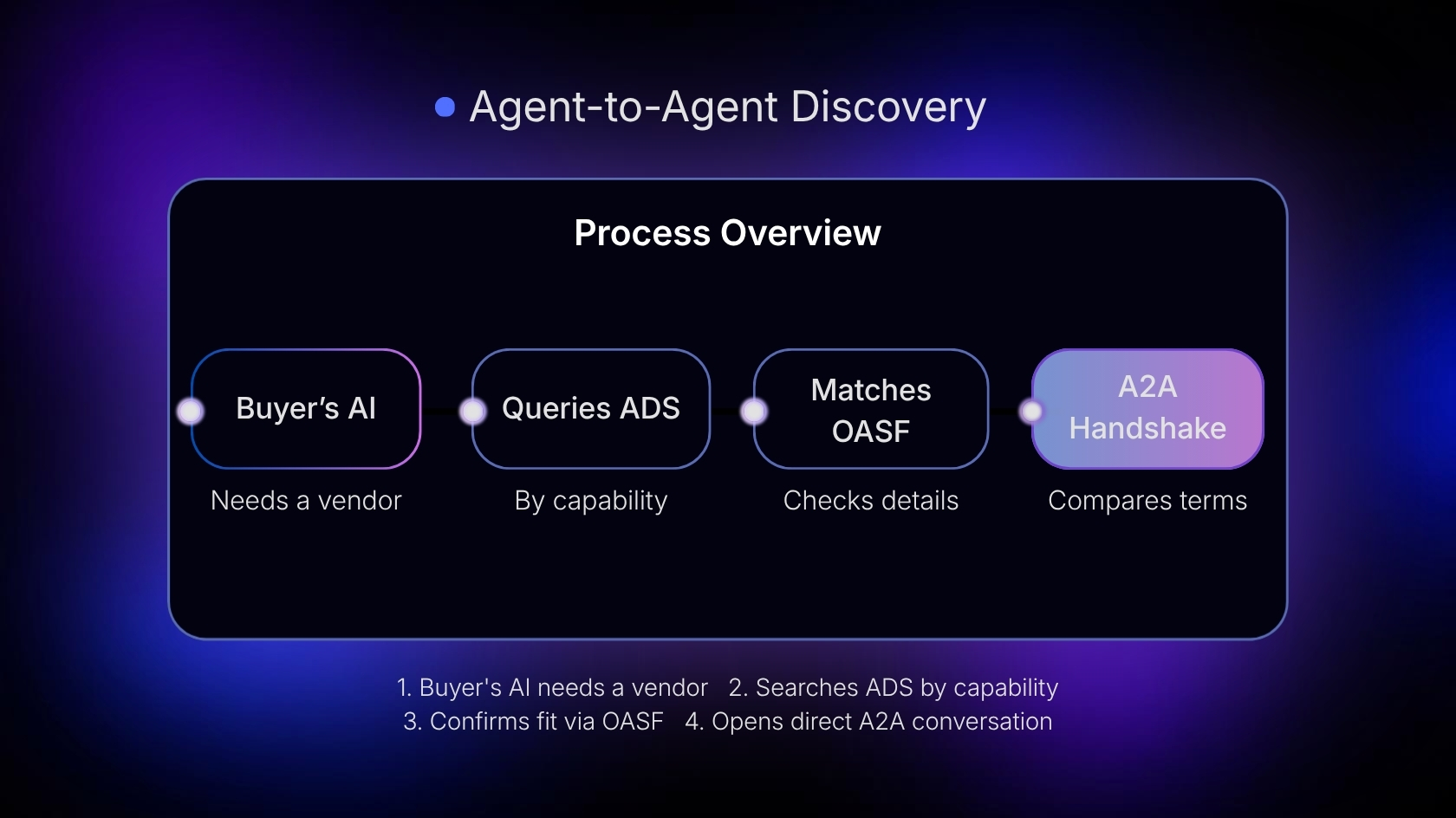
ADS, the Agent Directory Service, is the discovery layer of the open-source AGNTCY project. Rather than one central catalogue, it's a federated network of independent nodes that publish and resolve agent records among themselves, so an agent can be found by what it can do rather than by name. A buyer's assistant searching for a supplier queries nodes like this instead of a page of search results.
3. OASF | The Schema That Makes a Record Machine-Readable
Open Agentic Schema Framework, the OASF, describes what an agent is and what it can do, in a format machines can parse. A record without a valid OASF structure can't be read by the platforms searching for it, no matter how complete the underlying business information is.
How to Make Your Business Discoverable to AI Agents
Four steps, in order: fix the content an agent will read, publish an A2A Agent Card, publish your agent record to ADS, and keep the OASF record accurate as your business changes.
Fix the content first. An agent can only verify what's written down, structured, and current. The underlying content and structured-data work has to be right before any protocol-specific step matters.
Publish an A2A Agent Card. This is what lets another agent discover your capabilities and open a direct conversation instead of reading a static page.
Publish your agent record to ADS. A card nobody can find accomplishes nothing – the ADS record, built against a validated OASF structure, is what makes the card discoverable in the first place.
Keep the OASF record maintained. An unmaintained record points agents at a version of your business that's no longer accurate, which is a trust problem more than a technical one.
The Differences Between AI Agent Discoverability and SEO
SEO earns a business a place on a page a person scans. Agent discoverability earns it a place in a shortlist an agent builds and acts on, sometimes without a person scanning anything at all.
This comparison table showcases the differences between the two:
Traditional SEO | AI Agent Discoverability |
|---|---|
Optimizes for a person reading a results page | Optimizes for an agent reading your content directly today, and increasingly for one querying a machine-readable record |
Ranking signals: backlinks, keywords, page experience | Discovery signals: structured content and Schema.org now, A2A Agent Cards and ADS records as adoption grows |
Wins a click | Wins inclusion in a shortlist, sometimes with no click involved |
Measured in rankings and traffic | Measured in whether an agent can find, verify, and transact |
What Should You Check Before You're "AI Agent Ready"?
Four things determine readiness: content accuracy, protocol and directory presence, transaction safety, and upkeep.
Content accuracy and structure. Facts, prices, and policies match across every channel, with no page an agent would have to guess at.
Protocol and directory presence. An A2A Agent Card is published, and the business's agent record is live on ADS with a validated OASF structure.
Human handoff readiness. A person is set up to step in when an agent hits something it shouldn't handle alone; the same boundary that governs agent-to-agent transactions applies here too.
Ongoing maintenance. The record updates the moment the business changes – an agent trusts a stale record about as much as no record.
FAQs About AI Agent Discoverability
The questions below come up most often once a business understands what agent discoverability requires. Each answer is direct enough to act on without rereading the rest of the article.
What is AI agent discoverability?
AI agent discoverability is whether an AI agent can find your business, verify what it offers, and interact with it directly, without a person having to browse your website first. Today, that mostly depends on machine-readable content that AI answer engines can read. As agent-to-agent discovery grows, it will also depend on a published Agent Card and ADS record.
How do I make my business discoverable to AI agents?
Fix your content so it answers questions directly. Then publish an A2A Agent Card, publish your agent record to ADS, and keep the OASF structure accurate as things change, to get ahead of what's arriving next.
How do AI agents find and choose which businesses to show?
Today, answer engines read your content directly. As agent-to-agent discovery matures, agents will also query ADS for businesses matching a requested capability, confirm what each one offers through its OASF record, then open a direct conversation through A2A to compare price, availability, and terms.
What is AGNTCY's Agent Directory Service (ADS)?
ADS is the discovery layer of the open-source AGNTCY project, not a single company's catalogue, but a federated network of independent nodes that publish and resolve agent records among themselves. It lets an agent be found by what it can do rather than by name.
What is the A2A protocol?
Agent2Agent protocol is the open standard that lets one AI agent hold a direct conversation with another instead of reading a static listing. Google created it, launched it in April 2025, and donated it to the Linux Foundation two months later (Linux Foundation, June 2025).
Is llms.txt enough to make a business AI-discoverable?
For today's answer engines, llms.txt is genuinely useful; it points them toward your most authoritative pages. It does nothing for agent-to-agent discovery, though; that requires an A2A Agent Card and an ADS record, which llms.txt doesn't provide.
Do small businesses need an AI agent?
Any business whose customers might ask an AI assistant to find a supplier needs a way for that assistant to find them. Forrester's State of Business Buying, 2026, based on nearly 18,000 global buyers, found generative AI searches have become the starting point for vendor discovery and evaluation, though buyers still lean on human validation before deciding (Forrester, January 2026).
Start With One Agent Card, Not a Rebuild
Agent discoverability comes down to a small, specific set of additions to what already exists: content built for how AI answer engines already read the web, and an Agent Card, ADS record, and validated schema as agent-to-agent discovery grows. None of it requires replacing a website or a CRM.
Try the Anro Agents demo to see how it works, or start for free to build and test your agent – publishing to ADS is available on Starter and above.