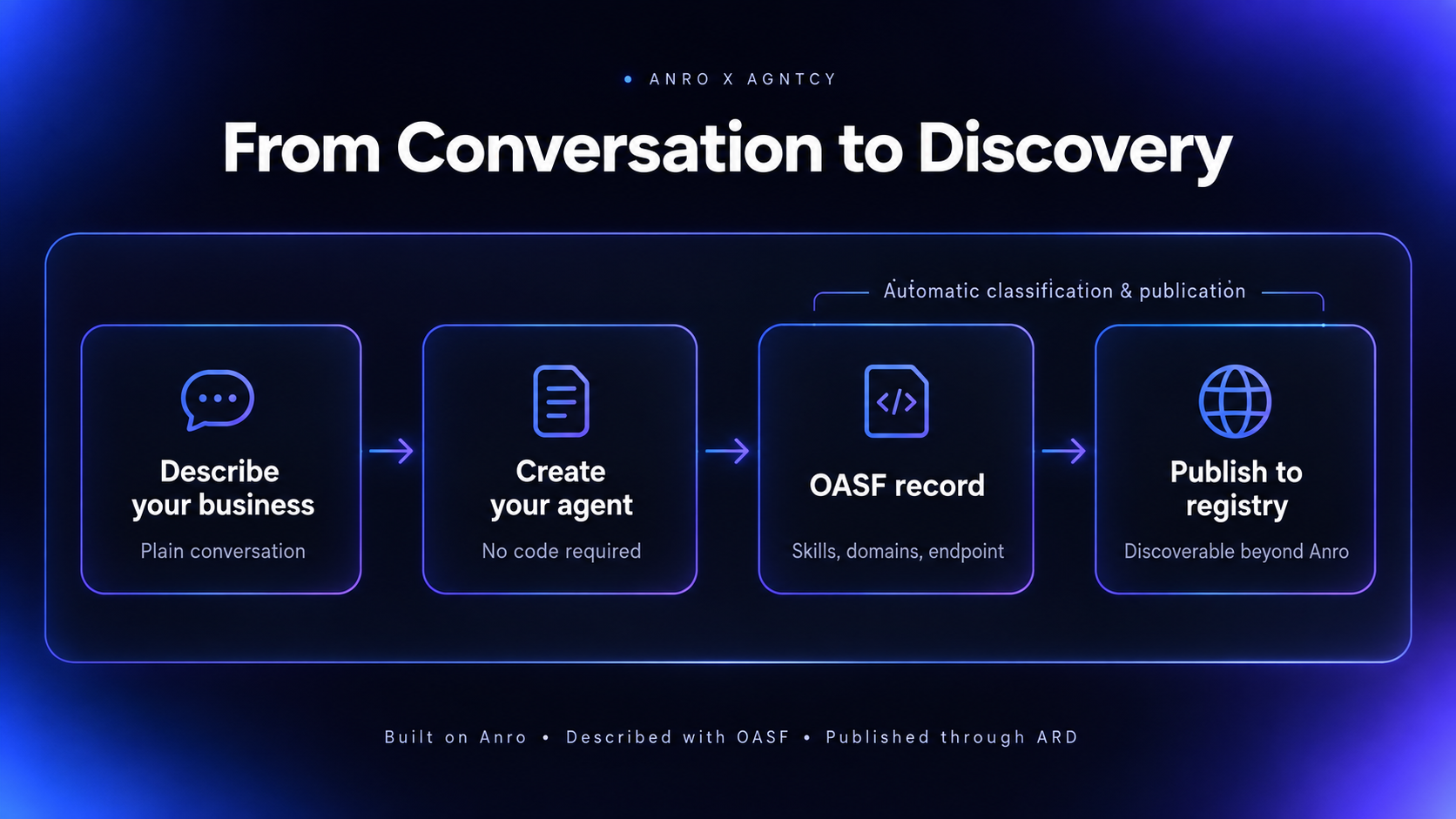
Every business agent we host is described as an open OASF record — and once it's published, a buyer's AI assistant can find it through a registry anyone can query, without ever having heard of us.
Summary:
• Anro describes its hosted agents as standardized OASF records and publishes them through an open registry it operates — so an agent built on Anro can be discovered beyond Anro's own platform.
• Business owners create agents through plain conversation — no dashboard, no engineering team — and classification and publication happen automatically underneath.
• The OASF descriptions are portable — they carried over intact when we moved our publishing layer forward, without a single one being rewritten.
When we started Anro Agents, the goal was simple: let any business — not just ones with an engineering team — stand up an AI agent that actually does something of value, leading to more business. Answer potential customers, qualify leads, provide tailored quotes, plug into the tools they already use. That works today, and it's what most people see first.
But we built Anro on a longer bet: agents won't only talk to people — they'll talk to other agents. An agent that exists only inside one product, invisible to everything outside it, is at a real disadvantage in that world. So alongside the platform, we built the infrastructure to make every agent we host discoverable, describable, and verifiable by the rest of the agent ecosystem. That's what led us to AGNTCY.
Why an open schema, not a proprietary listing
AGNTCY is an open standard, backed by the Linux Foundation, for making AI agents discoverable and interoperable across vendors and platforms. We chose AGNTCY because it solved the part we couldn't solve alone — a vendor-neutral way to describe an agent, signed portable records, and discovery with no central gatekeeper — backed by governance that won't pull the spec out from under us.
We've since put that portability to the test in the most direct way possible: we moved our entire publishing layer forward.
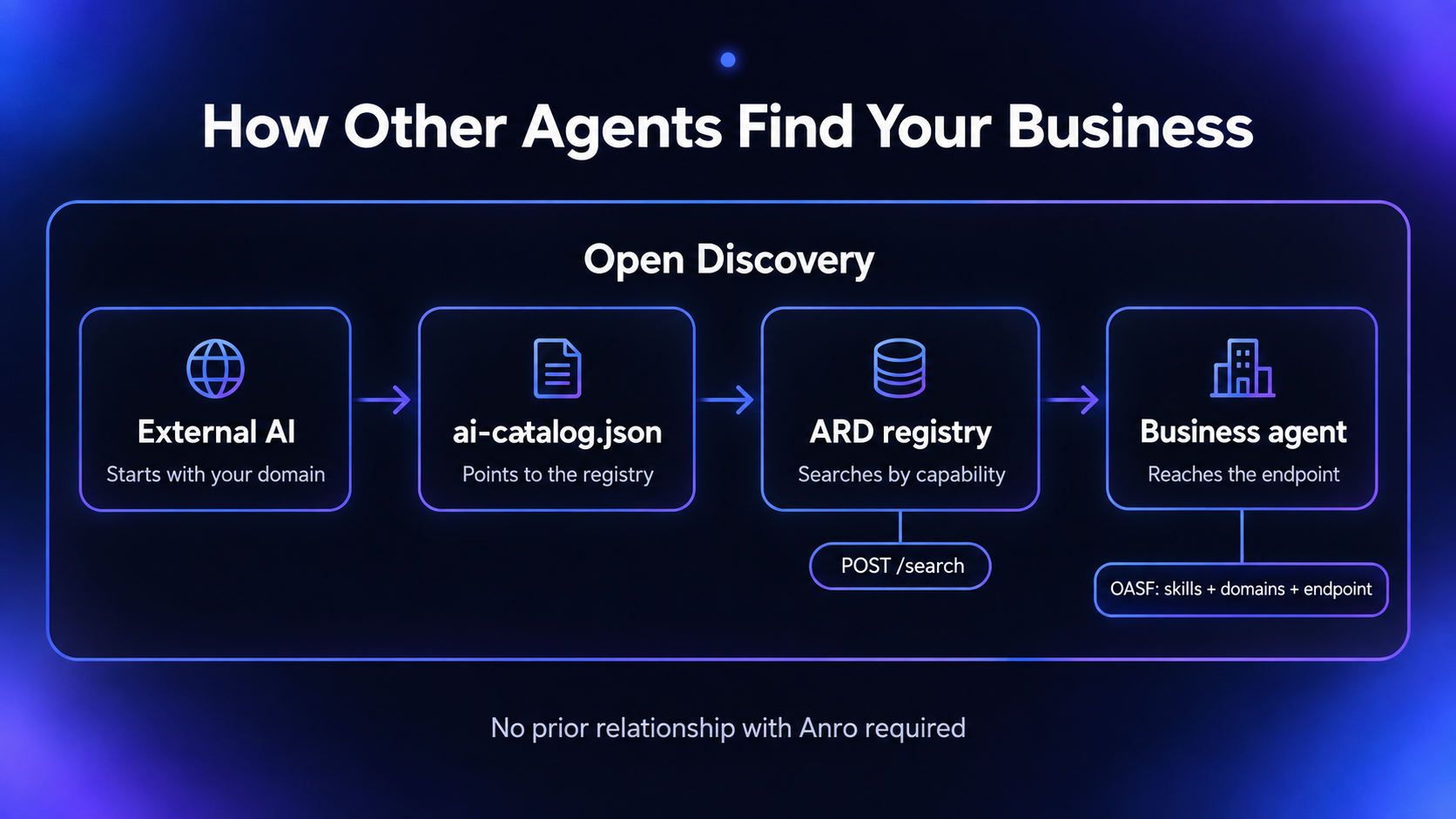
We started by running our own AGNTCY Directory node — the deepest form of participation available to us at the time, and the thing that taught us what publishing agents at scale actually demands. That experience is what pointed to the next step. We now publish through an ARD registry we operate ourselves. The commitment is the same one we made at the start — our own infrastructure, not a tenancy in someone else's catalog — applied to a thinner contract. The reason was narrow and practical: ARD makes exactly one endpoint mandatory — POST /search over plain HTTP, discovered through an application/ai-registry+json entry in a domain's ai-catalog.json. That contract is small enough that a crawler nobody coordinated with can read anroagents.com, find the registry, query it, and reach a customer's agent — which is precisely the promise we make to a business that publishes with us.
What did not change is OASF. Every agent we publish is still classified against it, and the schema carried over to the new surface without modification — the same skills and domains now feed the tags our registry filters on. That is the argument for an open schema, stated more concretely than we could have stated it a few months ago: the description outlived the system it was written for.
What we built
Every Anro agent is described as a standardized OASF record. OASF — the Open Agentic Schema Framework — is the open format AGNTCY defines for describing what an agent does and how to reach it: its skills, its capabilities, and its endpoint, captured as a versioned, portable record.
Nobody has to federate with us explicitly. Our registry answers the one query ARD requires, our manifest is published at a well-known path on our own domain, and any registry or crawler that reads it can reach the agents listed there with no prior relationship to Anro.
Discovery only matters if the other side can trust what it finds. The trust manifest in our catalog is signed, and the key that verifies it is published as a did:web document on the same domain — so a querying agent can confirm cryptographically that the publisher behind these listings is anroagents.com before it acts on anything it reads. On a discovery surface that matters: an agent should be able to tell where a record came from, not just that it was reachable.
Every agent is set up the same way any Anro agent is — through a normal conversation, no dashboard required. Classification and publication happen underneath, automatically. Business owners shouldn't have to understand OASF records to benefit from them.
Why AGNTCY matters for Anro
We leaned on AGNTCY's open standards rather than reinventing them:
• Open Agentic Schema Framework (OASF) — a vendor-neutral way to describe each agent's capabilities and skills
• A shared taxonomy — skill- and domain-based discovery that means the same thing to a registry we don't operate
• Portable records — agents described as open records aren't locked to our database, or to any one publishing layer, as we proved when we moved ours
• Open governance — the spec isn't a vendor's to withdraw
The result: an agent built on Anro is a first-class, portable participant in the network — not a row in a single vendor's catalog.
What classifying real businesses taught us
Assembling an OASF record for a small business sounds like a lookup. It isn't. Each record is built in three layers, and only the last one involves a model:
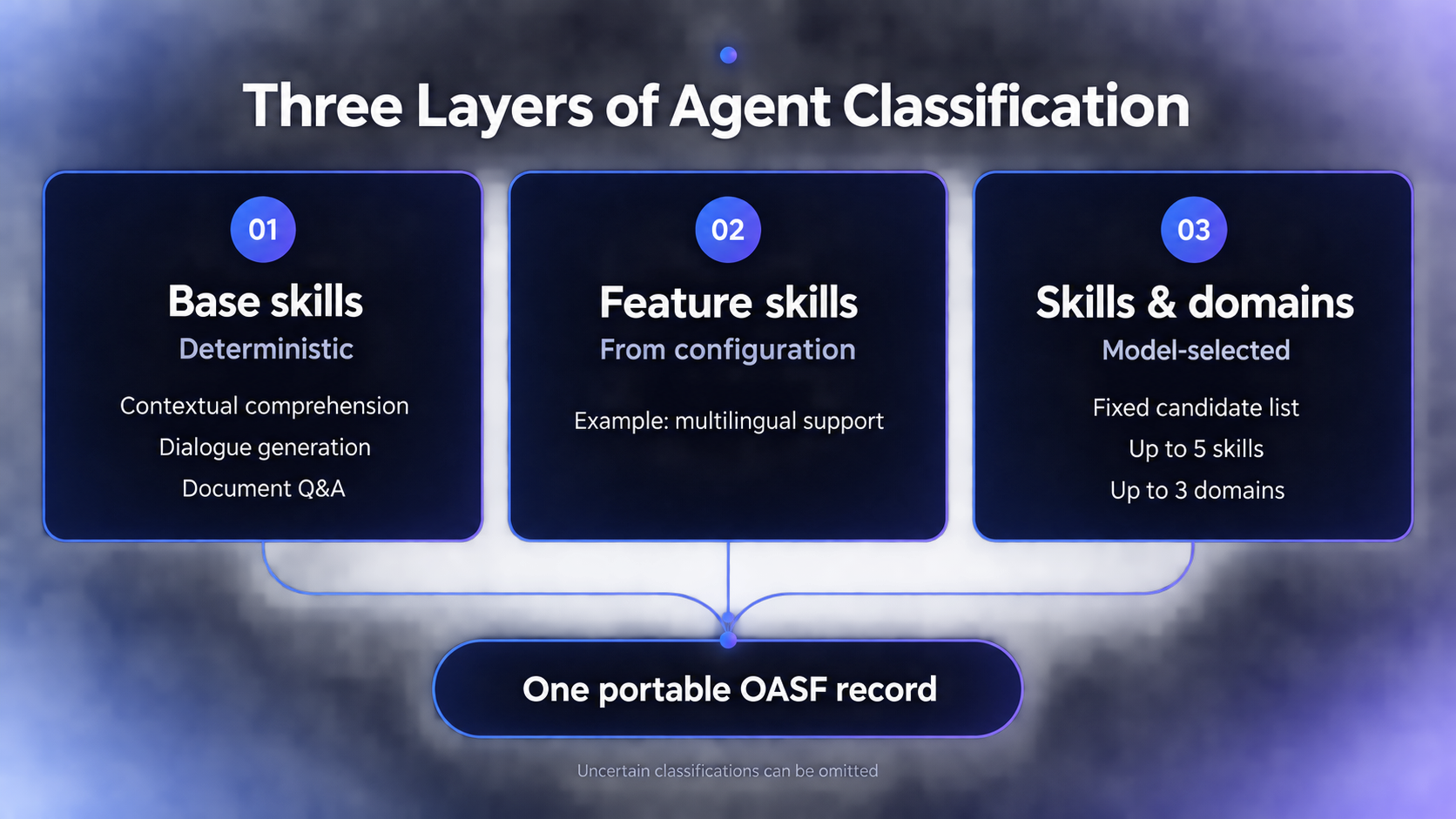
• Base skills — deterministic. Every conversational business agent gets the same three: contextual comprehension, dialogue generation, and retrieval-augmented document question answering. True by construction, not inferred.
• Feature skills — read from configuration. An agent set up for more than one language gets the multilingual skill.
• Skills and domains — the model's job. An LLM sees the business name, description, services and FAQ topics, and picks from a fixed candidate list: at most five skills, at most three domains, instructed to omit anything uncertain.
The model never invents a taxonomy node and never sees an id it couldn't legally use. Which means the candidate list — not the model — is the classifier.
We learned that the expensive way. Our first candidate list had eight domains, written before we had customers to check it against, and reading it back it's plainly a list written by engineers describing themselves: software engineering, information technology, security, finance, accounting. Then real businesses arrived, and a law firm came out classified as finance_and_business/finance. So did a property developer. Neither legal nor real_estate was on offer, so the model did what a helpful model does when forced to choose: it picked the nearest available thing rather than returning nothing.
That matters more than a mislabel, because a domain is a discovery filter. An unclassified agent is invisible; a misclassified one is misdirected, which is worse.
So we rewrote the list around the segments we actually sell to: 25 domains spanning legal, real estate, hospitality, retail and e-commerce, healthcare, education and marketing, alongside the original technology and finance entries. Two guardrails did as much work as the longer list — a hard cap of three domains, because in a discovery filter precision beats coverage, and explicit permission to return nothing, because a pipeline that can't represent "none of these" can never tell you the taxonomy is incomplete.
The first cohort of classified businesses bore that out. The two most common domain families are now precisely the two that were missing at the start — legal and real_estate. Every one of those assignments would previously have landed in finance. They wouldn't have looked like errors. They'd have looked like a fintech platform.
One note for anyone upgrading schema versions: a skill id is not a stable identifier across minor versions. Moving from OASF 1.0.0 to 1.1.0 renumbered the skill taxonomy, so carrying our old ids forward would have produced records that were schema-valid and semantically false — and nothing would have rejected them. We re-derived every id from the live schema instead.
What it unlocks for businesses on Anro
Standardized, discoverable records open the door to interactions that never touch a human or a contact form:
• Scheduling and booking — a patient's AI assistant finding and booking directly with a wellness coach hosted on Anro, no human in the loop
• Real estate — a buyer's AI assistant reaching a developer's Anro agent to qualify interest and book a viewing, no callback required
• CRM and sales — an inbound AI agent qualifying and routing directly to a business's Anro agent, bypassing the contact form entirely
And any platform that can read an ARD registry can discover and engage these agents — expanding the reach of every business on Anro without them doing anything additional.
Why we are building this now
We could have shipped the simple version — agents that live only inside Anro — and waited to see whether an open discovery standard took hold. We chose not to:
• Discoverability is the whole point — an agent only your own customers can reach isn't much different from the support widgets of the last decade. The value is in agents that other agents can find, evaluate, and engage directly.
• Build on open infrastructure, don't rebuild it — AGNTCY already gives us the schema (OASF) and a taxonomy many independent operators can agree on.
• Agents should outlast any one dashboard — a portable, standard record means an agent's discoverability never depends solely on Anro. It also meant that moving our publishing layer forward cost us no descriptions.
What's next
Density. Our registry answers the query the spec requires and our manifest is live, so the mechanism works; what it needs now is a catalog worth querying. That means publishing our full set of customer agents, and making our own systems resolve agents through the registry at runtime instead of hardcoded endpoints.
Beyond that, the questions we think are worth working on with this community are the ones classification surfaced: how implementers should build candidate sets that fit the population they're classifying, how minor-version renumbering should be communicated, and how a registry should distinguish "classified, nothing fits" from "never classified" — because the first is feedback about the taxonomy, and today they look identical.
If you're building on AGNTCY too, we'd like to hear from you — explore the standards and join the community at AGNTCY.org. The network gets more useful with every peer.
Anro Agents helps any business deploy an AI agent — no dashboard, no engineering team required. Get started.